Saturday, January 07, 2012

2011 Reading List

Since I'm having a difficult time refiring my writing engine, I thought I'd do something quick and simple by reviewing my reading for 2011.  This was, after all, intended to be a blog mainly about books when I first started.  Maybe some day I'll even post the two years I skipped.  Long gone are the years of reading 50 or more books; this year I managed only these 12:

1) Alexis de Tocqueville - Democracy in America - Much more interesting than it sounds, but much too long to keep me interested.
2) Johann David Wyss - The Swiss Family Robinson - When Mr Rogers Neighborhood meets Survivor...  I nearly gagged on the optimism.
3) Stephen King - Duma Key - Enjoyable but not especially memorable.
4) Harry Sievers - Benjamin Harrison: Hoosier Warrior
5) Harry Sievers - Benjamin Harrison: Hoosier Statesman
6) Harry Sievers - Benjamin Harrison: Hoosier President - A very up and down biography; at times great, at times mediocre.  Sievers seemed more a cheerleader for a dead president than a historian.
7) Stephen King - Under the Dome - King's best in a long time.  Still, he has a knack for building up these wonderful worlds, then having no way to escape them without a decisive and sudden conclusion that is nearly always a disappointment.
8) Daniel Keyes - Flowers for Algernon - I liked the idea much more than the book.
9) Richard Hough - Captain James Cook, A Biography - Interesting, but really all Cook did was sail around the world making charts, which hardly makes for scintillating reading.  The most engrossing section was the narrative of Cook's death at the hands of the Hawaiians.
10) Pat Conroy - The Prince of Tides - I have been unnecessarily avoiding this book for years, but it was outstanding, and I'm glad to have read it on the suggestion of a friend.
11) Joseph J Ellis - Founding Brothers - Excellent history clearly written. 
12) Jane Austen - Sense and Sensibility - Jane Austen writes the same thing over and over, chapter after chapter, book after book.  A true one-trick pony.  It's a great trick, but....

My book of the year, narrowly edging out Founding Brothers. It got a boost in my mind for being recommended by a wonderful friend with whom I was able to discuss the book, which always makes reading more valuable and fun.

Labels:

Thursday, January 15, 2009

2008 Reading List

When I started this blog, I intended to post reviews of all the books I read. That lasted for approximately one book, with a few more reviews scattered over the months. So, to make up for that I thought I'd post a list of all the books I read in 2008, with my recommendations or criticisms included. And even this is late, since I intended to post it while watching football on New Years Day. Oh well...life gets in the way sometimes, but here's what I read in 2008.

1) Isak Dinesen - Out of Africa - Boring
2) William C. Davis - Look Away: A History of the Confederate States of America - I'm not sure the author's analyses were always backed up by the facts, but this was a very educational book.
3) Omar Khayyam - The Rubaiyat - Don't know why this is a classic.
4) E. B. White - Stuart Little
5) Eugene O'Neill - Long Day's Journey Into Night - Repetitive and not very interesting.
6) Edmond Rostand - Cyrano de Bergerac - Silly.
7) Thornton Wilder - Our Town - I don't remember a thing about this book.
8) Cait Murphy - Crazy '08 - Great book, capped by the Cubs (the Cubs!!) winning the World Series. And, it's a true story!!!!!!!!!!!!
9) Theodore Dreiser - An American Tragedy - Very long, but very good.
10) Maureen Ogle - Ambitious Brew: The Story of American Beer - Informative and fun look at the American beer industry, tilted a bit too heavily, at times, toward Anheuser-Busch.
11) Edward Steers, Jr - Blood on the Moon: The Assassination of Abraham Lincoln - Just the right amount of detail about a story I thought I knew.
12) Bill O'Reilly - Who's Looking Out For You - Typical conservative trash. O'Reilly can do better than this.
13) Kemp P. Battle - Great American Folklore - Much too long.
14) Joel Chandler Harris - Uncle Remus: His Songs and Sayings - Most disappointing book of the year. I thought I would like this, but it wore thin really fast.
15) Patrick F. McManus - They Shoot Canoes, Don't They? - Not very funny, which for a book of humor is not good.
16) Louis L'Amour - Last of the Breed - Horrible writing, stupid characterizations, awful book.
17) John Koessler - Names of Israel - Surprise book of the year - every section taught some good lessons.
18) Charles Frazier - Cold Mountain - Great story, but with arrogant writing.
19) John S. Carbone - The Civil War In Coastal North Carolina - I don't normally like topical history with such a narrow scope, but this was okay.
20) Jay Winik - April 1865 - Excellent history.
21) Thomas Keneally - American Scoundrel - Disappointing. Good, but disappointing.
22) Shel Silverstein - Where the Sidewalk Ends
23) Fred Saberhagen - The Lost Swords: The First Triad - Typical fantasy, these three books have been on my shelf for about half my lifetime and now I can finally get rid of them.
24) Fred Saberhagen - The Lost Swords: The Second Triad
25) Fred Saberhagen - The Lost Swords: Endgame
26) Booker T. Washington - Up From Slavery - Good stuff and easy to read.
27) Richard Bachman - Blaze - From Stephen King's alter ego, this book was surprisingly great.
28) Alexander Solzhenitsyn - One Day In the Life of Ivan Denisovich - Outstanding. I can see why this is a classic.

Labels:

Wednesday, December 19, 2007

Book Review: Prayer by Philip Yancey

I've been reading Prayer for at least six months and finally finished. I'd read two or three days in a row and then put it aside for a week or three. I didn't mean to do that, but that's how it worked out. And, thinking back, I probably benefitted from reading it this way.
Yancey didn't set out to create a "how-to" book on prayer, but, by not doing so, I think he actually succeeded in creating a how-to book better than the actual how-to books. He doesn't give you any step by step guidelines or Things You Have To Say when praying. He simply examines the issues he has - and they're the issues we all have - with prayer. His conclusions were very helpful to me in understanding prayer and how I go about talking with God. Most of all, I think he helped me overcome the worry that I was doing it all wrong, as if there is a right way to pray that can be laid out for every person and every circumstance.
It helped also to have read the book during a period when many of my prayers were answered in the way I had hoped (which has rarely happened before). Some of those prayers were big, some small, and some were just off-the-wall-can't-be-answered-type prayers God brought to mind while I lay awake at night thinking of everything from work to friends to the Cubs, who are beyond prayer. Maybe that's a sign that I'm finally learning to pray for the right things.
I didn't agree with everything Yancey said. I don't know that I disagreed with anything he said either. It's just that a few things were beyond my comprehension. And that's all right. What I did understand was helpful and, early returns indicate, life changing.

Labels:

Tuesday, December 11, 2007

Book Review: Good to Great by Jim Collins

I don't normally like reading business books. As a subject, business just isn't that interesting, but Good to Great is one of the exceptions. The reason, I think, is that it deals with more than just business, but also touches a little bit on psychology and relationships, both of which can drive our work.
Jim Collins led a research team seeking to uncover the reason "why some companies make the leap...and others don't," which also happens to be the subtitle of the book. Collins and his team began by identifying 11 companies that, after years of being mediocre or decent companies, became great for a sustained period. I won't bore you with the details of how they defined a great company, since that's not the interesting part of the book. Once they had their great companies, along with a set of comparison companies that failed to become great, the Collins' team conducted extensive research to uncover what the great companies did differently than those that remained simply good (or worse).
The conclusions are best described as brilliantly simple, and, I guess I'm not too surprised to see, they are often principles I've been taught all my life. Very briefly, the concepts practiced by the companies that made the leap boiled down to these: strong but humble leadership that welcomed questions and conflict; getting the right people on board before determining direction; be completely and, if necessary, brutally honest; finding out what you are passionate about and what you can do better than anyone else; having discipline of thought and action; only invest in technology that will set you apart (I know I've phrased that poorly, but it comes down to refusing to chase after every new technology - a company should not be driven by the pursuit of fancy new toys); keep pushing - don't give up - and be positive if you know you're going the right direction. Many of these principles - humility, honesty, discipline, persistence - you might recognize from another old book we've all studied (amazing how that works!).
None of the "good to great" companies had leaders who acted as the savior or who tried to drive the organization with their brilliant ideas - that's the reason they brought the good people on board. None of the companies made excuses about being "second generation" or a bad economy or, in the case of Philip Morris, an increasingly hostile social attitude toward their industry. They simply faced reality.
Collins' writing was easy to understand and his illustrations were interesting and apt. I appreciated that they used quantitative research only to back up the qualitative. That is, they didn't focus on numbers, which can be easily twisted, to conjure up points they wanted to make. They kept the numbers in reserve until they had isolated a concept that was proven by the "good to great" companies.
Good to Great is well worth reading if you are interested in business or if you care about the business for which you work. It was the best book I've read in a long time.

Labels: ,

Saturday, November 17, 2007

Book(s) Review: The Dark Tower by Stephen King

Stephen King's fantasy saga The Dark Tower is one of the longest, most ambitious works in a genre that is home to long, ambitious works. Fantasy writers just can't seem to keep their creations to a single volume.

I started the series back in the 1980s but decided to put off reading the entire thing when I learned the extent of King's plans for the story. Beginning in 1982, the first four volumes were released over spans of five, four, and six years; I can't remember the details that long, so I waited 'til I could read it all at once. King finished the series with a flurry, with volumes five through seven all published in 2003 and 2004. I think his near-fatal accident in 1999 (he was hit by a car) caused King to truly get down to business on The Dark Tower, the first line of which he wrote back in 1970. He said he didn't want an Edwin Drood in his catalog.

And, after 3,948 pages, it turns out the first line ("The man in black fled across the desert and the gunslinger followed.") was the best part of the entire series. As King himself wrote, "The rest might have been puff and blow, but, man, that was clean." It also turns out, however, that the author's assessment wasn't entirely correct. The ending was brilliant. But the middle - if you consider the 3,946 pages from the second line to the final two pages the "middle" - really was just puff and blow. The Dark Tower was a promising idea, a western/fantasy hybrid, but it wound up being standard fantasy from an author whose writing talent can't possibly catch up with his imagination (something King himself has admitted, if I interpret his remarks correctly). There were the doorways between worlds, characters with Methuselah-like life spans, magic talismans, and, of course, the strange creatures, both terrible and lovable, that inhabit any fantasy epic worth its salt.

The ending, as I said, was brilliant. It was brilliant because, unlike the rest of the book, it wasn't the typical fantasy. Without going into details, we learn on the final page that Roland, the hero, is doomed both to forget and repeat his history, so his whole quest for the Dark Tower is one he has likely repeated countless times before and one he just might repeat into eternity. King did throw in one hint, one ray of hope, that Roland's next trek to the Dark Tower just might be his last. At first the ending maddened me, but, as it sunk in, I began to realize it was perfect. The ending was almost shocking after investing so much time reading all seven volumes, all the while assuming I knew how it would turn out.

I'm glad I finally read the whole series, but King sure could use an editor to tighten things up. As with all of his work, The Dark Tower could have been much more concise, much more intense. But it's Stephen King. You don't read his books for literary fulfillment.

Labels:

Saturday, October 27, 2007

Book Review: The Card by Michael O'Keeffe and Teri Thompson

The Card, which carries the subtitle, "Collectors, Con Men, and the True Story of History's Most Desired Baseball Card," is about the recent history of the famous 1909 T206 Honus Wagner card. More accurately, The Card is about The Card - the Gretzky T206 Wagner, which was the first, and as far as I know, only, baseball card to sell for more than a million dollars (it sold for $2.35 million earlier this year). The card earned its nickname when hockey great Wayne Gretzky became part owner of the card in 1991.

The Card is a fun, quick book, just over 200 pages long, including appendices. Chapters detailing the history of The Card since its discovery in 1985 are intermingled with chapters about the business and history of baseball cards, players' compensation for use of their image, the history of card collecting, and, of course, Honus Wagner. The authors even make a case for Wagner as the greatest baseball player of all time. While there is some validity to their argument, it would likely be accepted by few fans outside Pittsburgh. Along with Ty Cobb and Babe Ruth, Wagner was one of only three offensive players in the National Baeball Hall of Fame's inaugural class (1936). In fact, Wagner received the same number of votes as Ruth, and more than twice the votes of Cy Young, who failed to make the cut. So while those who saw him play counted Wagner among baseball's greatest legends, very few of today's fans remember him for more than his appearance on an expensive piece of cardboard.

The T206 Wagner, while not the rarest baseball card, is the rarest card in what is probably the most desired set for collectors of vintage cards. Without going into too much detail, the controversy surrounding the card stems from its almost pristine condition. How can a piece of cardboard survive in such great condition for so many decades? Further adding to the debate, there have been questionable practices and conflicts of interest among the original buyer, auction houses, and the company and individual graders that authenticated the card.

O'Keeffe and Thompson attempt to prove that the card has been altered, and, although there is no smoking gun, I think they succeed. My guess is that most people would agree, but it will probably have little impact on the value of the card. The card's recent fame is based partly on the mystery and the controversy and partly on the intriguing cast of characters who have owned it, Wayne Gretzky being the most famous, but not necessarily the most interesting. In fact, Gretzky sold the card to Wal-Mart for use in a give-away promotion. The winner of the promotion was announced on an episode of Larry King Live, featuring a panel that included Tommy Lasorda and Barry Bonds. Other owners of the card have ties (having nothing to do with the card or the controversy) to such people as Rudy Giuliani and George H.W. Bush. All of these things, but especially the controversy, only serve to make The Card more interesting, more collectible, more valuable.

The only problem I had with the book was its National Enquirer-like tone. I shouldn't have been surprised, though, since the authors work for the New York Daily News, which seems to exist for the sole purpose of dredging up dirt on as many people as it can. That tone makes me wonder if they presented the evidence in its entirety or if they are only telling part of the story. On the positive side, the authors spent just the right amount of time on each chapter, providing sufficient information to move the story along without getting bogged down in details. I recommend this book for any fan of baseball history, even those who don't collect cards.

Labels: , , ,

Sunday, August 19, 2007

Book Review: St. Dale by Sharon McCrumb

Even before getting our drivers licenses, and even before we moved, I signed up for library cards for the Chalotte/Mecklenburg County Library. A day after unpacking, I headed to the local branch intending to get back into the Carp 500 (click the Carpe Libra link on the right for more information). However, when I came across Sharyn McCrumb's St. Dale, it seemed appropriate, as a NASCAR fan, that this was the first book I check out as a resident of North Carolina.

St. Dale tells the story of a group of diehard Dale Earnhardt fans embarking on a memorial bus tour the year after Earnhardt was killed on the final turn of the 2001 Daytona 500. The book is less a story, though, than a bundle of NASCAR trivia and history wrapped loosely around a very simple plot. Each fan, or pilgrim, on the tour had reasons to say their final goodbye, including one whose car Earnhardt had fixed on a dark Mooresville road - several months after his fatal wreck at Daytona. The story doesn't get very complex, so there isn't much else to say. It was occassionally funny, and I enjoyed the old racing stories and the characters were very well done. McCrumb managed to be both respectful and skeptical of the outpouring of grief, which really did become a bit bizarre, following The Intimidator's death.

Speaking of which, the author claimed to be exploring how Americans choose their saints these days, as opposed to canonization by the Church, but I didn't really feel educated after reading the book, so either she failed in her presentation or there just isn't much substance to the subject. Or it could be that I just don't care.

If you're not a race fan, you probably wouldn't appreciate St. Dale, unless you happen to be a big fan of Sharyn McCrumb. I liked it, though, and I rate it a 7 out of 10.

Labels:

Thursday, October 05, 2006

Lincoln at Cooper Union

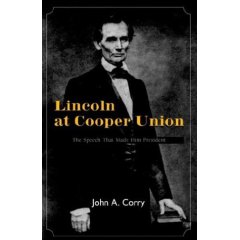
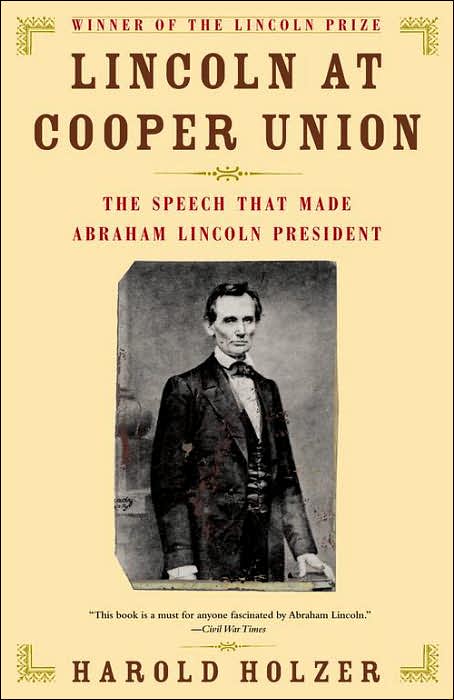
A few posts back, I described my attempted visit to Cooper Union, where Abraham Lincoln made one of the most important speeches in U.S. political history. I mentioned that I had read two books about the event. Both books had the same title, with the exception that one used "Him" in the subtitle while the other used "Abraham Lincoln."

In case you're interested, the book by Holzer is the more scholarly, in-depth of the two. If you can't read enough about Lincoln and consider yourself an expert, this is the book for you. On the other hand, Corry's book is a well-written (but poorly edited), straightforward narrative of how Lincoln came to be invited to New York, his trip, and the aftermath of the speech. Even those who aren't so gung-ho about history might enjoy Corry's book.


I've always enjoyed learning about Lincoln. My political views cause me to question how good he really was for our country, but he is still one of the most fascinating people in all of history.

Labels:

Saturday, May 27, 2006

Book Review: Peter Pan

Maybe I've grown too old, but I couldn't help thinking Peter was the bad guy in this book. It seemed full of nonsense and downright horrible thoughts (not happy thoughts at all), and I just don't get it.

I give it a 4. I'd rather read the peanut butter label.

Labels:

Saturday, May 20, 2006

Book Review: In Cold Blood by Truman Capote


In Cold Blood tells the story of the 1959 murders of four members of the Clutter family in Holcomb, Kansas. Capote called the book "creative non-fiction" because, I think, he gets inside the minds of the characters and relays their thoughts to the reader. As far as I've been able to find out, Capote got all the facts straight.

I was somewhat disappointed in the book, mainly because I had very high expectations. For some reason I had the notion that Capote helped solve the crime, when in reality it was an inmate in the Kansas penitentiary who provided the information that put investigators on the right track. This is, of course, a fault with the reader (me), but it does show how our attitudes and assumptions can help ruin a book.

Not that In Cold Blood was a bad book. I enjoyed it, just not as much as anticipated. Capote does a nice job weaving the stories of the criminals and investigators together to give the book some degree of drama, even though you know what's going to happen. Certain parts, particularly after the arrests were made, were bogged down by detail. I had read that Capote was able to build sympathy for the murderers, but apparently I missed that part. The two killers came across as crass, unlikable, evil men, and I didn't have one bit of sympathy for them. I am moderately, but not completely, against the death penalty, but even when Capote narrated the hanging of the murderers, I still had no sympathy. Either I'm cold-hearted or Capote's ability to arouse compassion is over-rated.

Overall, I'd rate In Cold Blood a 7. If I wasn't in a good mood today, I'd rate it a 6.

Labels: